
Why does folk music collector Alan Lomax have a copyright interest in “Takeover” by Jay-Z?
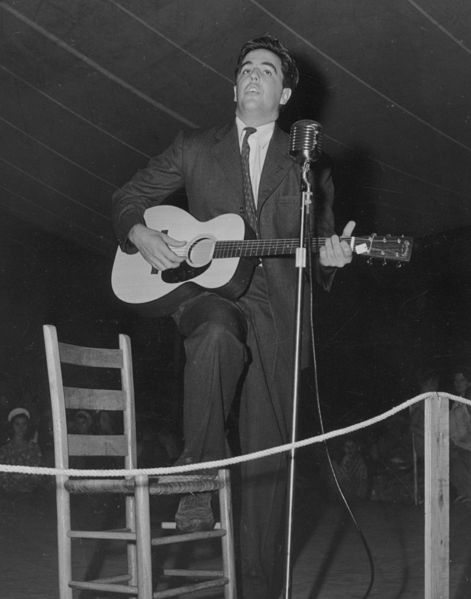
I learned the answer from Creative License: The Law And Culture Of Digital Sampling by Kembrew McLeod and Peter DiCola. It’s a companion book to the invaluable documentary Copyright Criminals. The story of Jay-Z and Alan Lomax isn’t quite as epic a copyright failure as the Biz Markie lawsuit or the story of “Bitter Sweet Symphony” but it’s still pretty absurd.
So here’s Jay-Z’s “Takeover.” Explicit language ahead:
For my tastes, “Takeover” isn’t one of the better Jay-Z songs, since all it does is make fun of Nas. It’s depressing when an artist of Jay’s caliber devotes his considerable creativity to a diss track. Still, the production is pretty powerful. The main samples come from the Doors’ “Five To One.” Jay also quotes David Bowie’s “Fame,” along with various other rap songs. Finally, the sampled line “Watch out, we run New York!” comes from “Sound Of Da Police” by KRS-One.
KRS-One samples a riff from “Inside Looking Out” by Grand Funk Railroad — listen at 6:28.
Grand Funk didn’t write the song; it’s a cover of The Animals.
The Animals didn’t really write the song either. As was a common practice among their British rock peers at the time, they took a folk melody and wrote somewhat different lyrics. The tune they used is called “Rosie,” which they learned from a recording made by Alan Lomax of a chain gang at Parchman Farm.
“Rosie” can’t be said to have any particular author. But Lomax was the first person to record and publish it, so according to the peculiar norms of America’s property laws, he was able to copyright it. Not only does Lomax hold the copyright for “Rosie,” he’s also listed as a co-author of both versions of “Inside Looking Out.”
Here’s where the story gets truly silly. When KRS-One sampled Grand Funk Railroad’s cover of “Inside Looking Out,” he needed the permission of both the owner of the recording and the underlying composition. This is in spite of the fact that the sample is from an instrumental section that Grand Funk added, and that doesn’t reference the original melody at all. And even though Jay-Z sampled KRS-One’s unaccompanied vocal, he also needed to get copyright permission from everyone sampled in KRS-One’s track. Including Alan Lomax.

So that’s how a folk song collector wound up as the legal co-author of a Jay-Z diss track. I can’t think of a better illustration of the copyright system’s dysfunction than that.
The copyright maze is no obstacle to Jay-Z — he has the money, lawyers, and connections to clear whatever he wants. But what about up-and-coming or unheard-of artists? What if they want to use samples? Should the most vital art form of our time be the exclusive province of forty-year-old multimillionaires? And grateful as I am to Alan Lomax for recording and disseminating so much great folk music, I remain baffled as to why he was allowed to copyright it. Our creative heritage deserves better stewardship than our current laws provide.
Update: I seem to have touched a nerve with this post. Jesse Walker posted it on the Reason Magazine blog, and since then it’s also been on Andrew Sullivan’s blog, Metafilter and Techdirt. There are some interesting discussions happening in the comments to those posts. Thanks for linking, everybody!


He was, at the heart of it, a racist and the music industry is no different. I work in the industry in music rights for sound recording. He really should not be on the recording. When I get back to work I will check if it’s still the case. Sound technicians, engineers etc. do not get royalties. For a sound recording it’s only people who made an audible contribution. So the estate of those men who were singing need to get a case together to take to court. They should be claiming rights. The estate of Alan Lomax should be forced to pay back money as well.
You have it wrong. The song arrangement was copyrighted by MacMillan publishing, the publisher of Lomaxes’ books. Lomax is not listed as “artist”. On the actual contract he is listed as “collector and arranger”. · Lomax’s biographer John Szwed writes “Collectors copyrighting folksongs was not unusual at the
time. Carl Sandburg, Zora Neale Hurston, Bela Bartok, Cecil Sharp,Percy
Grainger, Ralph Vaughn Williams, and even Lawrence Gellert, the most
politically leftist of all the collectors, all filed claims for copyright,
though none of them shared earnings with the singers.” Alan did share his
earnings with the singers from whom he collected.
·
· SSzwed also says that neither
Alan Lomax nor his father ever filed claims for copyright on individual songs.
This was done by a large music publisher, whom Alan Lomax sued in the 1950s,
winning a partial settlement in which he was allowed a portion of the author’s
half of the earnings (contrary to his wishes) as collector and arranger. He
would have preferred to have had publishers’ credit. Thus, Lomax is being
excoriated today for winning a settlement in a lawsuit with a large corporation,
quality blog ,Ethain , what about this crazyness too .
http://www.smh.com.au/news/entertainment/news/2010/02/04/1265151932344.html
Oooh, I didn’t know about this. Will definitely be looking into it more deeply.
I became curious, in particular, about Alan Lomax’s ethics in collecting those songs and copyrighting them. From some quick examination of various articles readily available on the web, I found a variety of conflicting positions. However, the best one, to me, seems to be this one from the Enccyclopedia of World Biography:
‘Respected rock writer Dave Marsh is
among the critics of Lomax’s methods. Responding to the glowing New
York Times postmortem tribute by Jon Pareles, Marsh, wrote in
Counterpunch
, “As a veteran blues observer wrote me, ‘Don’t get
too caught up in grieving for Alan Lomax. For every fine musical
contribution that he made, there was an evil venal manipulation of
copyright, publishing, and ownership of the collected
material.'”
‘Like many publishers, promoters, agents, and even disc jockeys of his
time, Lomax did impose his publishing imprint on a great many public
domain songs. However, when a published song made money, Lomax proudly
tracked down the writer in question and paid the
royalties—something few of his contemporaries did. Further, the
thousands of performers he captured on recordings would have never gotten
a chance to share their culture and songs if he had not sought them out.’
Read more: Alan
Lomax Biography – bio, life, family, story, death, wife, school, young,
son, book, old, information, born, college, movie, house, time, year http://www.notablebiographies.com/supp/Supplement-Ka-M/Lomax-Alan.html#ixzz1XlsHEpK7
So, yes, he had the copyright and was probably definitely infected with a bit of the “white savior” myth, but, according to several sources I’ve read (and there is clearly controversy on this point) he did it in part to keep major record labels and artists from simply poaching from people who were not really in position to defend themselves against these bigger forces, and part to keep himself fed, because he never became really rich from all the work he did. And he seems to have–sometimes against his father’s wishes–helped Leadbelly out of prison, etc., and helped keep his family from starving.
I’m no expert, but it seems like there are many worse characters in the field of cultural appropriation than Alan Lomax.
I completely agree that Lomax isn’t any worse than anyone else in his era and position, and in many ways better. I think the problem is the system of laws and values that Lomax and the musicians he recorded were working within. I don’t have anything against Lomax in particular; it’s more the idea that anyone at all should be able to own folk music that bothers me.
Copyright law allows and indeed encourages people to copyright versions or arrangements of traditional (i.e., folk) songs. The publisher would take fifty percent and the author (frequently also the publisher using a false name) would take the other half, giving some to the performers, as they saw fit. It was a longstanding practice of tin pan alley and of performers to copyright traditional songs in a fictitious name. This was the case with The Richmond co and other music publishers. See Rian Mallan’s fascinating article on this in Rolling Stone, later made into a documentary film: reprinted here:
http://www.3rdearmusic.com/forum/mbube2.html Also the wikipedia article on Wimoweh.http://en.wikipedia.org/wiki/The_lion_sleeps_tonight
No one comes out of the wood-work evening giving a damn about a copyright until the songs goes platinum via a hip-hop genius.
http://www.reverbnation.com/play_now/song_7363570 What part of this is copyright infringement?
By the way…here’s the video.
http://youtu.be/8r0azV_mIIo
This is to the author: You clearly have NO clue about hip-hop music or the artists you write about! Jay-Z used that very song to “cement” his position as the KING of hip-hop, by disgracing & dethroning the former King (Nas). Copyright law is around to protect someone’s original works! Just because it’s popular in hip-hop & the music business in general to “sample”, it’s NOT OK to just help yourself to anyone’s “original-work” (just like IP in technology). The system is designed to protect the “unknowing” copyright holder to individuals that choose to “knowingly” use copyrighted material. Your right, Jay-Z can afford to overlook the rules because he has money, but the average artist would be smart to work with non-sampled material. If you don’t want to get sued for copyrighting someone’s music, then the artists need to work with producers to NOT use samples in their beats. It’s that simple! Trying to make it seem like copyright/publishing is an evil practice because artists, producers, A&R’s & executives are all too lazy to make sure they are NOT liable for the work they try to “capitalize” on, is ridiculous! It’s just that simple!
I know a thing or two about hip-hop. I just care more about my own enjoyment of the music than who the “king” is.
Creatively,
I do think it’s alright to help yourself to copyrighted material. If
Alan Lomax can copyright public domain folk material, it seems like
copyright is more a matter of who has power than any higher moral force.
There would be no hip-hop at all if the first generation of artists
didn’t feel free to sample copyrighted material.
Jay-Z isn’t “overlooking” the rules, he’s obeying them. He licenses everything. He and Kanye are
among the few commercial artists out there who can afford to license at will and are thus free to pursue the
artform the way it was meant to be done. Kanye said it best: “God don’t
send me nothing I can’t handle, so please don’t ever give me records I
can’t sample.” I want the freedom enjoyed by Jay and Ye spread down the
food chain, it would make for a healthier culture.
I’m a trained jazz musician. I’ve composed professionally in many different styles. I’m perfectly capable of producing music without using samples. But I prefer sampling when I can do it. The process is more challenging and emotionally engaging, and the results sound better. Copyright isn’t evil, it’s just too heavily weighed towards the interests of large corporate entities like Disney and the major labels. Shorter terms, compulsory licensing of samples and expanded fair use would give us a better balance between the needs of creators to profit from their work and the needs of everyone else to move ideas forward.
Before copyright, dudes were getting guns held to their heads, with NO place to run to! You’re a musician that thinks it’s OK to use someone else’s material with no repercussions?! Doesn’t make any sense. If I got “Jay-Z” rich off of your music (without even an acknowledgement) you’d be pissed! Even if you wanted to take the “moral” high-ground, your lawyers would be obligated to sue on your behalf anyway! They’d tell you that you have to protect your “original-work”. Not just for you, but for all artists trying to own their own material. You honestly think Jay-Z & Kanye pay for sample clearances out of their own pockets? Ya right! That’s why they make major deals with big entities. Major labels are there for these very reasons. Like you said, the average artist cannot pay for any of their “off-the-top” expenses (clearances, legal, travel, food, clothing, marketing/advertising, placements, etc.). Plus, usually, this is the main reason you read artists are broke & have nothing to show for themselves after the labels recoup on their investments. That’s why so many artist started making deals where they got their own labels & became responsible for their careers & finances. An artist like Jay-Z just took it to the next level. Jay-Z signed a $150M deal with Live Nation (the world’s #1 concert promoters). They gave him ownership of all his music (publishing rights), Rocafella records (roster of artists, that are signed) & Rocawear (worth over $300M/year, he sold it for $235M, keeping 35% in shares + control of designs). He got $100M, up front. He only has to put out “3” records, tour them, promote them. They also gave him his own label “RocNation” + a management wing (more money). He manages some of the biggest publishing-rights artists in the music business! Samples are expensive & sometimes un-negotiable (e.g. Fabolous – “Breathe” Prod. By Just Blaze. The owner of the original sample found out about the song 5 months later, after the song went nearly platinum & became Fabs’ biggest hit to date. The publishing owner wanted 100% publishing rights + $100,000, making the use of the sample or performing the song WAY too expensive for both artists. Therefore, Fab & Just had to stop using that song all together. It doesn’t play on the radio or in clubs.) The result a major loss & waste of time, for all involved (I heard the video cost a pretty penny + Fab blew is 1st advance on a Bentley GT). In the end, I’d rather have someone like you that can play real sounds. Then I’d just have to pay you, with an agreement. All those songs you mention that would’ve never come out without samples are connected to artists that are broke in 2011. Show money is nice, but publishing money is WAY better. Just ask Neyo, Keri Hilson, Jay-Z or Timbaland! A great example of this is actually Jay-Z. He won’t let anyone re-use his voice or previously recorded lyrics on any song. Doing so will require a hefty price that Jay-Z himself says NO one can afford! That’s how you protect your stuff & keep it from getting watered down by low-levelers! Get permission first!
Like I said, I’m not opposed to copyright. I just think there needs to be a reasonable balance between copyright owners and creators. A compulsory licensing scheme or something similar would ensure copyright holders would get paid while avoiding situations like the one you describe with Fabolous. And I’d prefer that copyrights lapse after twenty years, not the lifetime of the artist plus seventy. The original copyright term put in place by the founding fathers was only seven years; they would have been appalled by the current laws.
You should familiarize yourself with entertainment law before spouting off.
Kanye West sampled…
I don’t know if these additional issues are addressed in the book, but I thought they were worth noting.
First, copyright is a right reserved to authors. You can only assert rights in what you create as an author (unless you acquire the rights from the author). If Lomax didn’t acquire the rights, he couldn’t legally list himself as author, and his asserted rights were illusory. All sorts of early music biz types listed themselves as authors when registering copyrights in music actually written by other people, because nobody ever checked. They never had any right to do so.
Second, if the sample really comes from the a cappella version of the KRS-One song, Jay-Z’s sample clearance people licensed the wrong track. KRS-One’s label probably didn’t register a separate copyright in the sound recording of the a cappella, but they could have. The track would be credited entirely to KRS-One, since the a cappella contains absolutely nothing from the “Rosie” lineage. If that is the recording Jay-Z used, that is the recording they should have licensed.
http://www.allenlawnc.com
The book does address these issues in depth — it’s written by two copyright attorneys. I recommend it highly. This issue of copyrighting folk songs is a complex one. The book deals with it only briefly; it’s mostly concerned with modern sampling practice. But there’s quite a bit of intellectual overlap. In the case of Alan Lomax and “Rosie,” even a good-faith effort to uncover an original author of that song would have been fruitless; it no more has a single author than the Bible does.
The sample comes from the full KRS-One song, it just samples the very beginning when the vocal is unaccompanied. Though in general, if you sample an a capella version of a song, I’m not sure how copyright law applies. Someone who’s more of an expert than me will have to weigh in.
The book is written by a professor of communication and a professor of law and economics (whether he is a practicing entertainment lawyer is not clear). Why this book even mentions Alan Lomax is a mystery since his copyrights date from the 1950s and both laws and practices have changed considerably since them. The writers seem to be just trading on Lomax’s name, since what they do to have to say about him is completely speculative (“we assume” and so forth). Apparently they never bothered to interview anyone connected to him. Nor, in a book dedicated to sampling, do they even bother to mention the most famous and successful sampling of Lomax’s recordings by Moby!!!! Due diligence anyone??
Nevertheless, chapter 3 mentions (in passing) that “musical copyright” is distinct from other kinds of copyright. It also acknowledges that all kinds of people are put down contractually as “authors” besides those who actually wrote or performed the songs. The book also mentions that copyrights can be bought and sold and most often it is large corporations (music publishers) who end up getting all of the money, while the artists, band members and arrangers see very little. Needless to say, to find out about a particular copyright you would have to look at the specific contract for each song.
This is not correct. There is widespread public ignorance of the fact that the rules for music publishing copyright are not the same at all as those for print publishing, but are sui generis, and date back to the sheet music era. Under music publishing laws both publisher and author receive royalty income, split 50 / 50. These percentages can be and frequently are further subdivided in various ways among producers and arrangers. (Today recording artists normally form their own publishing companies to avoid having to give half their royalty income away.) After World War 2, when the sheet music publishers realized that they were losing income to the recording industry, they figured out they could make up the loss through publishing copyright income; and they began to raid the field of traditional music and copyright everything they could get their hands on, usually using pseudonyms and spinoff companies. They raided the entire Lomax catalog, claiming that the songs in the Lomax books, which had been edited and arranged by the Lomaxes, were public domain. The fact that the publishers agreed to a settlement demonstrate their awareness of the weakness in their case. However, Lomax would have preferred to have been offered a share from the publisher’s half rather than the artists’ half of the publishing right, as was not infrequently done. Lomax was advised by his lawyers, however, that the pockets of the music publishers were too deep for him to fight against. It may be argued that the attacks on the Lomaxes that persisted over the years were calculated to distract the public from the publisher’s role and to make him a scapegoat. Redbaiting may have also played a convenient role in this.
So there is no mention of the person who actually made the beat probably before Jay-Z knew about it? Yes, that would be Kanye West. Jay-Z just wrote the lyrics.
Kanye West gives life to Jay-Z much like he did with their new album Watch the Throne. Give at least some credit to Kanye in the article. Maybe I missed it but I didn’t see his name here at all.
Yes, my bad, I neglected to mention that Kanye produced the track. I’m a huge fan of Mr West and you’re right to point out my omission.
one more point: Superior lyrics by Nas >>> simple lyrics over sample nonsense
Jay-Z spoke the truth! Nas was just mad he banged his baby-moms! One’s now on top, one isn’t! Do the math!
nice article. Ether still destroyed Jay-Z and Takeover though.
This song finished Nas’ career! Shined a lot of light on his “fake” facade of an image, while Jay-Z’s career is an open book! This song & album propelled Jay-Z’s career, while Nas just reacted & played catch up until it was just pointless. That’s when he joined DefJam while Jay-Z was president. Jay-Z finished him the old fashioned way: he took everything from him (crown, his woman & his fame!!).
nobody respects jay-z like they used to after ether came out..thats why he started becoming a business man and stopped trying to rap..so if you think about it neither one of there rap careers excelled after that time period and if your talking about “fake images”, jay-z is definitely the one who has the fake image
Right! Jay-Z is worth over $600M. His wife, Beyonce is worth over $300M. They’ll easily be worth over $1B, in the next 10 years! Easily! Nas, makes $1.4M/year. His ex-wife Kelis, won a judgement of $55,000/month, just for child support! That’s almost half of Nas’ monthly-income. It’s been reduced to $35,000/month, but it’s obvious Nas can barely afford that, when he’s blowing $10,000/week on haircuts & shopping! Lame! Jay-Z hasn’t written a book or tried to star in a movie or be on T.V.! He only raps! That’s right, he’s made almost a billion-dollars rapping!
Listen to Grand Funk’s (GFR) lead guitar riff at 4:20 of their iteration of Inside Looking out. KRS uses the GFR riff at least three times during three breaks in Sound of da Police. (E.g., the middle usage starts at about 2:22 of their song, and again near the very end of the song.)
Good stuff. Thanks for breaking this down. Perfect example and personally I also ask the questions ” Should the most vital art form of our time be the exclusive province of forty-year-old multimillionaires?”
good article. just as a minor bit of info the song dwells on Prodigy from Mobb Deep much more than on Nas
Lomax and his father were subsidized by the LOC but didn’t work for them, and it was their own equipment, if memory serves. The LOC got the right to release the recordings, which are pretty amazing given the technology of the time, the conditions and the fact that their car was their recording studio.
This is a great post. All my life, I’ve said to myself, where did I hear THAT before when hearing a new song.
What makes this most interesting is the Grand Funk part. One guitar lick unrelated to the underlying song, sample by some guy 40 years later, makes Lomax the writer of the JayZ song? That’s demented.
As for Lomax getting the copyright in the first place, IIRC, he gave writing credit where he could, but otherwise put his name down as author, since something had to go there. I doubt he had dollar signs in his guileless eyes; the commercial potential of these recordings was about $8.57 in royalties back then and I doubt he could have foreseen the folk and British invasion booms of 20 years later, both of which strip-mined his recordings for authentic inspiration and turned a little backwater of popular music into million-sellers.
I wonder how much money he ended up with. Groups like the Animals seem to have voluntarily credited him, but I get the impression they were the exception.
Alan Lomax made considerable money off of assigning himself partial credit for other people’s songs. He admitted in his interview with Terry Gross that him getting part of the money on songs he hadn’t really cowritten was a way “for money to be — to come into my hands so I could continue to do research.”
Alan’s father John Lomax recorded Dobie Red and group singing “Rosie” in April 1936. Alan wasn’t there. The original file card for “Rosie” has “WPA” stamped on it (the Work Progress Administration was founded in 1935), so that would be taxpayers’ money coming in. John Lomax worked for the Library of Congress from 1936 on in a reciprocal arrangement, the Library of Congress providing recording equipment, him using songs he collected in books copyrighted in his name, and him fundraising for the Library of Congress by getting grants from the likes of the Carnegie Corporation. When Alan wrote to Woody Guthrie on 7/9/42 mentioning his “boss in Washington,” he was referring to his boss Dr. Harold Spivacke at his government job; Alan was Assistant in Charge of the Archive of American Folk Song, a division of the Library Of Congress. An example of something Alan wrote to Dr. Spivacke, on 3/23/42: “In my last note about [folklorist] Mr. [John] Work, I didn’t mean to imply that I thought we should not pay him.”
Great article. Crap, this is a clusterfuck.
Why was Pete Seeger allowed to copyright “Wimoweh” when it was written by a South African in the late 1920s?
Pete Seeger did not copyright Wimoweh, this was done by his publisher, who assigned Seeger a share of “author’s” rights. When Pete found out there was a known author, Solomon Linda, he immediately directed his publisher (Folkways/AKA Harry Richmond, Harold Leventhal, and Pete Cameron) to send his share of the (artists’ half) of the royalties to Linda. However, the publishers did not bother to do this and Seeger had no way of checking up on them. In fact although Seeger “renounced” his royalties, he continued to receive them, Rian Malan discovered. Pete was not very business like and was chagrined. No doubt he had let other people handle his finances. See the wikipedia article for this. Richmond continued to take a share of authors’ royalties (using a pseudonym) for the Tokens hit version (a rearrangement), which was copyrighted by Abilene music.
What research did Seeger and company — the Weavers — do into learning whether “Mbube,” as it was titled on the record they copied it off of, which had been a hit record in Africa, was a traditional song, rather than a recently composed song? None. Who was it credited to by the publisher? The pseudonymous “Paul Campbell.” Who did that mean the publisher sent the songwriters’ share of the money to? The members of the Weavers. Where did the publisher learn about this “Wimoweh” song from? That would be from the Weavers. From _Popular Music_ ed. Nat Shapiro: “Kisses Sweeter Than Wine Words by Paul Campbell (collective pseudonym for the Weavers: Pete Seeger, Lee Hays, Fred Hellerman, and Ronnie Gilbert), music by Joel Newman (pseudonym for Huddie Ledbetter*).” From _Sing Out_ magazine, 1960: “Campbell (the name is a pseudonym for the Weavers) is now credited with outright authorship, words and music, to… ‘I Ride An Old Paint,” … ‘When The Saints Go Marching In’…, and ‘Easy Rider Blues.'” Funny how Seeger wasn’t very businesslike in a way that made him a lot of money.
(*”Joel Newman” was reportedly actually a pseudonym for Ledbetter, John Lomax, and Alan Lomax; the Lomaxes being more guys who knew how to take a financial piggy-back ride. Pete Seeger said of the song “Kisses Sweeter Than Wine” in 1993, “Sam Kennedy.. taught it to us…. [I came up with] two new words….”)
Didn’t Lomax record all of that music as part of his job for the Library of Congress in the 40’s? So he can use his employers time and equipment to record a third party, take that recording to a label, publish it and get Copyright over it for until 2077? What a scam
Absolutely not. See above posts.
Copyright ownership of songs seems to work something like homeopathic remedies; no matter how much you dilute the original active ingredient, even if not a single atom of it remains in the final product, it’s still considered to be a vital part of the thing.
This is a perfect analogy! Mind if I use it?
You’re gonna have to license its use, duh.
Sure… I’ve got no problem with somebody remixing my ideas.
This is quality stuff. Keep bloggin’!