
“The Funky Drummer Parts One And Two” by James Brown and the JBs is one of the most-sampled recordings in history.
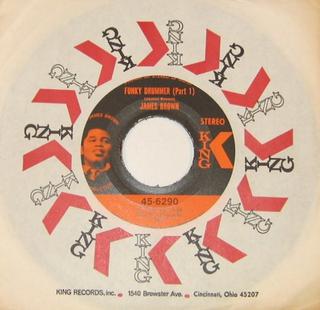
But even though the track is a cornerstone of hip-hop and other sample-based electronic music, for the first decade after its release, it was an obscurity. It’s not as catchy as James Brown’s big hits like “Sex Machine” or “Papa’s Got A Brand New Bag.” It is hardly even a “song” at all, and it doesn’t have verses or choruses; instead, it’s just an open-ended groove, with extended solos traded back and forth between James Brown on organ and Maceo Parker on tenor sax.
It’s a mother
Four and a half minutes into the recording, James Brown tells the band: “Fellas, one more time I want to give the drummer some of this funky soul we got going here.” He tells drummer Clyde Stubblefield, “You don’t have to do no soloing, brother, just keep what you got… Don’t turn it loose, ’cause it’s a mother.” That last word will turn out to be prophetic.
Though he was only eighteen years old at the time of the “Funky Drummer” session, Clyde Stubblefield was already a master drummer. On the recording, James Brown tells him not to cut loose and solo because it might break up the groove and let all the air out of the balloon. So when his cue comes, Stubblefield continues to play the main rhythm pattern, with more emphasis but not a lot of variation. James Brown does a short rap over the beat and then counts the band back into the original vamp. While the band plays, he names the tune on the spot: “The name of this tune is the Funky Drummer, the Funky Drummer, the Funky Drummer, the Funky Drummer, the Funky Drummer, the Funky Drummer… Maceo!”
In The Jungle Groove and the Bonus Beat Reprise
The Funky Drummer drum break was much-loved by the first generation of hip-hop producers. They sampled it enthusiastically and repeatedly. In 1986, Polydor capitalized on James Brown’s new-found street cred and put out In The Jungle Groove, a compilation record of the hard-edged, open-ended funk grooves preferred by hip-hop listeners. This compilation was the first album release of “The Funky Drummer Parts One And Two.” It also included a remix called the “Funky Drummer Bonus Beat Reprise.”
The Bonus Beat Reprise is a loop of the Clyde Stubblefield drum break for three minutes with James Brown’s sampled raps coming in once in a while on top. It’s a perfect hip-hop track right out of the box. You could throw some rhymes on top and it would be ready for the radio. If you wanted to remix it further, its gridlike structure makes it effortless.
Analyzing the break
Here’s a screenshot of the Funky Drummer break in Ableton Live.

What you’re seeing in the image is two nearly identical audio files, the left stereo side above, the right below. Each black blob is a drum hit. The bigger the blob, the louder the drum hit. The two biggest ones are the snare drum hits on beat two of each measure, the backbeats. The little grey triangles are metadata added by Ableton Live. They define the important rhythmic events. In the Funky Drummer break, every slice point is on a sixteenth note.
Here’s how you experience the loop when it’s played over and over. Read clockwise:

Clyde Stubblefield doesn’t play his sixteenth notes with perfect metronomic steadiness. He deliberately lays behind the beat in places, and he uses very light swing. There’s some further slight unintended deviation from his intended deviations. Your ear can detect the difference between the perfect sixteenth note grid implied by the loop and the asymmetry of the actual drum hits. This difference poses a puzzle to the brain, and gives the loop tension. Hearing the loop repeated is like a musical mantra, creating a relaxed intensity that gets more gratifying the more you listen.
The break gets around
The Funky Drummer break has been sampled in hundreds of commercially released tracks, and uncountably many more unofficial ones, from hip-hop to pop to rock to every flavor of electronica. The break has also been duplicated endlessly by studio drummers. James Brown even sampled the Funky Drummer break himself, on “She Looks All Types a’ Good.” No one loves the Funky Drummer more than Public Enemy. They use it on seven different tracks, and they namecheck it in the first verse of “Fight The Power“: “1989, the number, another summer, sound of the Funky Drummer.”
The Funky Drummer as a game
When you listen to the original “Funky Drummer,” you’re witnessing a performance. You’re free to dance, but there’s not much space in the musical conversation for you. The Bonus Beat Reprise, on the other hand, is an invitation to perform. All that open musical space is like a bare stage, all lit up for you.
You can think of the Bonus Beat Reprise as a game with a few simple, inflexible rules. You can add your own sounds on top, but they have to be in slightly swung 4/4 time at ninety-nine beats per minute. Your phrases have to fit in repetitive sequences of four, with phrases beginning and ending predictably every sixteen bars. The intermittent guitar stab weakly establishes the key of A, but you’re free to use whatever pitches you want otherwise, or none at all.
The Funky Drummer game is a very inclusive one. As long as your ideas are repetitive and to the beat, you can’t really do anything wrong. You can play on top of the Funky Drummer Bonus Beat Reprise out loud or in your head, in front of an audience, with a few friends or by yourself. You can rap, or sing, or improvise jazz solos, or lay down electronic squiggles and samples, or just chant, as James Brown’s sampled voice does:
Ain’t it funky now. Ain’t it funky now.
Ain’t it funky now. Ain’t it funky now.
Ain’t it funky now. Ain’t it funky now.
Ain’t it funky now. Ain’t it funky now.
The answer unquestionably is yes, yes it ain’t.
The Funky Drummer meme
Along with Apache and the Amen break, the Funky Drummer break is probably the most influential breakbeat in electronic music history. It’s a literal sex machine, a powerful replicator, a successful meme. As a digital audio file, the break is small, compact, lightweight, durable, modular and easily passed around. Even at CD quality, the break is a small enough file to send in an email, post on the web, and distribute on any disk or thumb drive format.
The original “The Funky Drummer Parts One And Two” is a long snaky beast that requires a very particular context to replicate itself. The drum break is more like a microbial gene cassette. It can make itself at home in the musical genomes of a seemingly limitless variety of new songs. You could find a way to set just about any piece of American popular music of the past two hundred years to the Funky Drummer break. If a traditional song or composition is like the genome of the macroscopic organism, a sample like the Funky Drummer break is like the rapidly evolving, stripped-down genome of a microbe. Like a microbe, the break spreads itself in concert with other replicators, as a guest, a parasite or even as the basis of new, more complex organisms.
Like successful genes, successful memes don’t always benefit their human hosts. Clyde Stubblefield got paid a one-time fee, musicians’ union scale, for the “Funky Drummer” session. James Brown is officially the song’s composer, and his estate receives all royalties people have been paying (those that have been paying them.) Clyde Stubblefield isn’t entitled to any of that money. He has the undying admiration of musicians, but that doesn’t pay as well as owning a copyright.
Clyde Stubblefield is in poor health. Show the Funky Drummer some love by contributing to his health care fund. http://clydestubblefield.chipin.com/clyde-stubblefield