
People had been playing electric guitar for decades before Jimi Hendrix. Mostly they used it as a louder, less effortful version of the acoustic guitar. Jimi was one of the first musicians to think of the guitar amp as a musical instrument unto itself, an early analog synth, with the guitar as a very sophisticated control surface.
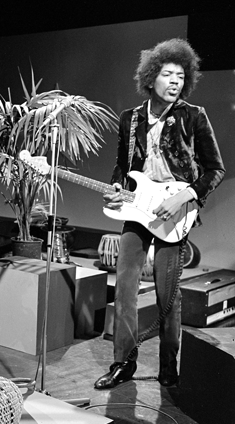
The electric and acoustic guitar are superficially similar, but they produce sound in totally different ways. Acoustic guitars make sound from vibrations of the body, driven by the vibrating bridge, which is in turn driven by the vibrating strings. The player controls the body’s vibrations by plucking and strumming the strings. All the power of the vibrations has to come from the player’s hands.
Electric guitars generate sound by moving a speaker cone in the amplifier, driven by current from the wall. This current is controlled by a much weaker current originating in the guitar’s magnetic pickups. As the metal strings vibrate, they agitate the pickups’ electromagnetic field, sending a fluctuating current down the cable and into the amp circuitry. Good amps respond dramatically to very subtle touches on the electric guitar’s strings that would be inaudible on an acoustic instrument.
Jimi Hendrix was one of the first guitarists to think of his instrument as a way to modulate an electrical signal first and foremost. He didn’t just pluck and strum the strings; he scraped them and swatted them and played with their tension. And he produced his most distinctive sounds by letting the amp itself vibrate his guitar’s pickups to create feedback loops. All of these techniques are at work in his iconic performance of “The Star-Spangled Banner” at Woodstock.
Jimi’s guitar is both feeding back and heavily distorted. He also throws in a little wah-wah pedal. The time is free, or as the classical musicians say, rubato. Jimi interlaces the melody notes with inharmonic screams and yowls, produced by scraping the pick against the string’s winding. He throws in a few unresolved tritones at 1:35 and some terrifying divebombing sounds at 2:00. At around 2:30, he quotes part of “Taps.” This performance has been criticized as anti-American, but Jimi said in interviews that he considered himself to be patriotic.
The first generations of electric guitarists considered feedback to be bad, a technical mishap to be avoided. Jimi discovered ways to use it as a musical expression in its own right. If the amp is loud enough, its sound can physically shake a guitar’s pickups enough to produce a current. That current gets sent to the amp, which then vibrates the pickups harder, which sends even more current to the amp, which produces even more sound. This feedback loop builds rapidly, getting louder and louder.
Every beginner electric guitarist discovers feedback accidentally by leaning their guitar against their amp without turning the volume down. Feedback can also be seeded spontaneously by the slight hum produced by any electrical system that uses alternating current, or by radio waves. Cheap, poorly shielded pickups and cables make great radio antennas. I used to live on Roosevelt Island, right across the East River from a Con Ed power plant with a whole bunch of big transformers. If I didn’t face due north while playing electric guitar, I picked up all kinds of radio signals and other electromagnetic noise. It was great for experimental music, but not so great for producing a clean sound.
Feedback is more likely, and a lot louder, when the guitar is overdriven, its signal boosted and compressed to bring out and sustain overtones that are normally inaudible. Feedback has a mystical quality, an evolving life of its own. It’s unpredictable and hard to control exactly. It would be pointless to try to score a feedback composition because there are too many variables at work. Feedback is an intrinsically improvisational medium. The results can be annoying or boring, or they can be transcendent. You can experience the visual equivalent by pointing a video camera at the monitor showing its own output.
Jimi was also a pioneer in his exploration of the electric guitar’s microtonal possibilities. The conventional way to control a guitar string’s pitch is to press it against the frets, changing its length. You can also bend the strings, changing both their length and tension, for more nuanced pitch intervals. Jimi played guitars with an additional pitch control, the whammy bar. This is a level that lifts the bridge, allowing very precise control of all six strings’ tension simultaneously. The whammy bar lets you play arresting microtonal chords effortlessly. It also quickly pulls the strings out of tune, which is why in the video Jimi is continually adjusting the tuning pegs whenever his left hand is free.
The video cuts out before this point, but at Woodstock Jimi segued from “The Star Spangled Banner” into “Purple Haze.” The song is based around a distinctive chord that has come to be nicknamed the Hendrix chord.

This chord is easy to play – any beginner could learn it – but it’s intellectually dense. It contains every possible interval in the Western tuning system, if you count inversions. Jimi didn’t invent the Hendrix chord; it had been a distinctive device in blues and jazz since before he was born. But where Duke Ellington and Thelonious Monk used the Hendrix chord for accents and embellishments, Hendrix pushed it front and center, using it as a cornerstone for songs like “Purple Haze” and “Foxy Lady” (in different keys than the one written here.)
The electric guitar doesn’t just offer a lot of the tonal and harmonic freedom. It also leaves the player’s mouth and feet free for more expression. You can use your feet to dance, or to control stomp boxes and expression pedals. Your voice is free for singing and talking. That is some seriously advanced interface design.
Great Column. Thanks for taking the time to help me understand how he got that sound. As I tell my young friends who extoll the virtues of the latest and greatest guitarists of this day, “yeah, but when Hendrix did it, nobody had done it before…he had to invent it before these guys could morph off of it.”
Great Remix!
Thanks for listening, glad you enjoyed it.
Really nice analysis of Jimi’s style. It’s quite correct that he recognized the amp as an analog synth, almost a separate instrument from the guitar. His timing was very good for doing so. After a few years of guitarists like Beck and Clapton messing with the wiring bugs in 1950’s Fender amps that unintentionally caused heavy distortion, Jim Marshall came along, just in time for Jimi, and built the first amps that were meant to create a new character in the sound, not simply make it louder. In turn, Jimi’s popularity drove the development of those amps. Jimi’s employee, Roger Meyer, also made a great contribution. He built Jimi devices that no one else had, like the Octavia that created the metallic sounding false harmonics on ‘Purple Haze’ and modified wah pedals and fuzz boxes (Wah pedals were originally designed for organ, to emulate a trumpet). It was a confluence of creative forces that put Jimi in a position to do what had never been done. I can only imagine what he would have been capable of had he survived another few decades.